Grundy, Alaska
How to Flirt with A Naked WerewolfGrundy, Alaska is the remote southeastern Alaskan settlement where Mo Duvall-Wenstein’s abandoned old life becomes an unexpectedly crowded new one. She arrives seeking distance after a broken engagement, but the town’s silence, labor, suspicion of outsiders, and hidden werewolf community draw her into relationships and conflicts that permanently alter her place in the world.
Setting and Arrival
Grundy first appears as an almost improbably small settlement. When Mo reaches the ornately carved welcome sign after thousands of miles of driving and a three-day ferry trip from Washington, the sign announces a population of 2,053, and her arrival is immediately framed as an addition to that number. The move began as a frustrated reaction to her broken engagement and a desire to get as far from her hometown as possible without changing citizenship. A brief online search led her to Grundy and to the Meyers place, a six-hundred-square-foot rental with one bedroom, a living room, a bath, a kitchenette, and a forest view from the porch. She resigned from Gulfside Marketing, surrendered her lease, and committed herself to a town she had barely seen.
The first view of Grundy unsettles her expectations. From the highway, she can see the whole town at once: a long main drag, a few side streets, several dozen irregularly arranged one-story houses, and many more isolated homes spread across roughly fifty square miles around the town limits. Main Street resembles an Old West settlement, with old brick buildings pressed together against northern winters. The bank, grocery store, and outdoor outfitter advertise practical necessities rather than urban variety, while the mountains rise at the edge of town in a protective curve that makes Mo’s private worries about fuel mileage and landlords seem suddenly small. Even before she meets anyone, Grundy establishes its governing contrast: severe remoteness paired with a tightly maintained human foothold.
Isolation and Material Life
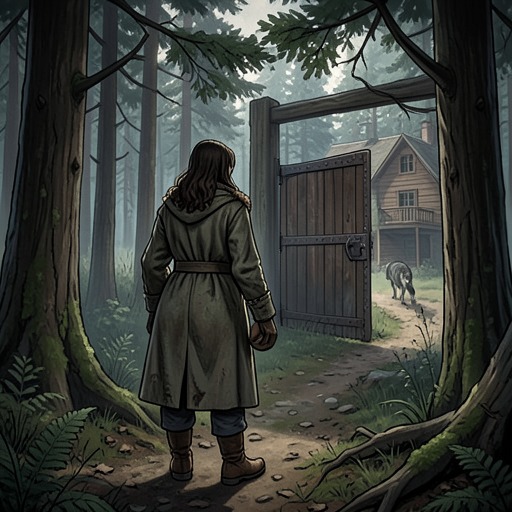
Mo’s house lies fourteen miles outside the town limits and half a mile from the highway at the end of a winding gravel drive. The distance produces a silence more extreme than the suburban seclusion she knew in Leland, Mississippi. In Grundy, she cannot hear neighbors’ conversations or car stereos; she listens for any sound that might prove the cabin is real and that her former life has truly been left behind. The quiet is not merely scenic. It makes the settlement’s physical separation tangible and turns ordinary domestic tasks into encounters with the surrounding wilderness.
Her first hours in the new home become the Great Dead Fish Hunt. Fish have been left in the refrigerator, bathroom sink, and utility room, including some hanging from a string. Mo cleans them out and double-bags the remains rather than placing them outside, because exposed food would signal to bears that her lawn offers an all-you-can-eat buffet. The episode introduces Grundy as a place where local knowledge is practical, unglamorous, and necessary for survival. Mo is not initially terrified of bears or wolves; experiences with alligators, snakes, and other animals in Mississippi have given her a rough confidence. Yet the dead fish reveal that Alaska demands a different kind of attention to the consequences of ordinary actions.
The town’s buildings embody the same economy. Every structure is occupied, and every square foot serves a purpose. Closed businesses can become storage rooms, an improvised church, or extra classrooms for the high school, because harsh weather and the cost of shipping construction materials make new construction difficult. Grundy therefore functions as a material system as much as a backdrop: scarcity encourages maintenance, shared use, and resistance to waste. Its apparent smallness conceals a dense infrastructure of adaptation.
The Blue Glacier and Community Belonging
The Blue Glacier Saloon is Grundy’s central social and economic crossroads. It combines a general store, restaurant, and bar, a hybrid institution suited to a town where commercial space is too valuable to separate into specialized venues. For Mo, it is a fantasy realized as a place resembling a roadside shop that also serves drinks. The saloon gives her access to the friendly voices and chatter absent from her isolated cabin, and it becomes the first room in which she feels both involved and protected by a degree of privacy.
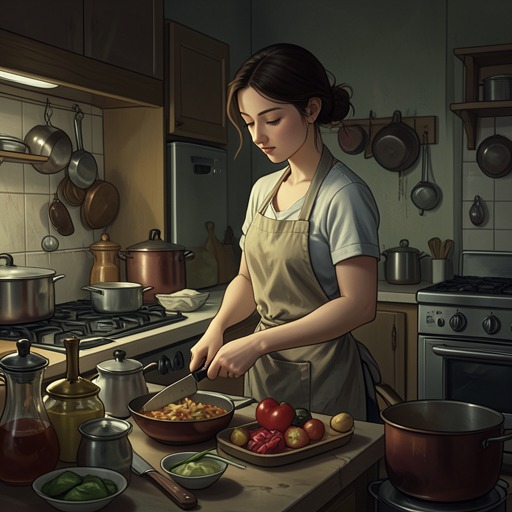
Mo’s connection to Grundy begins through labor. When Buzz DuChamp is injured while demonstrating a bottle-cutting technique and must go to the doctor, Mo offers to take over the grill. She has worked her way through school at a drive-in, recognizes that the hamburger patties and vegetables are already prepared, and knows how to handle short-order cooking while orders accumulate. Evie DuChamp soon offers her full-time work during Buzz’s absence and suggests that she take over the baking as well. Evie’s reasons are concrete: Mo does not faint at blood, helps a near stranger, cooks consistently, and leaves the tip jar untouched despite opportunities to steal.
Accepting the job changes Mo’s relation to the settlement. She had planned an idle life in Grundy, but the kitchen makes her feel like part of the room without surrendering all privacy. The saloon’s work gives her an everyday route into local society, and the decision to remain there becomes an emotional as well as economic commitment. Her later menu reform extends that process. Mo and Evie plan to replace the old menu under the pretense that Pete has dropped the existing stack into the sink, using practical deception to alter the saloon’s food and its future. By the time Mo marries Cooper Graham, Evie and Buzz offer her a twenty-percent share in the business because receipts have risen by at least that much since her arrival. They even prepare a nursery in the Glacier’s office so she can continue working after maternity leave. The saloon thus turns an outsider into a worker, then into a stakeholder.
The workplace also becomes the town’s information exchange. After Mo’s friendship with Evie suffers a minor strain over the werewolf crisis, drinks and Sandra Bullock-based confections repair the relationship. The next morning, a customer asking for Mo is announced through the dining room, and Eli appears at a booth to see her. Ordinary service, gossip, flirtation, and supernatural politics occupy the same physical space. Grundy’s social network is therefore not abstractly communal; it is carried through counters, orders, shared food, family visits, and the repeated visibility of people who cannot remain strangers for long.
Outsiders, Family, and Hidden Networks
Grundy’s welcome is conditional. Alaskan residents are described as distrustful and exasperated toward outsiders who arrive seeking peace, fulfillment, or a life off the land. A person may live there for twenty years and still be treated as an outsider. Mr. Gogan warns Mo that Susan Quinn, known locally as Susie Q, will not deliver her mail until she survives her first winter; Mo must collect it at the post office herself. Even the postmaster’s eccentricity is absorbed into the town’s intimate structure: Susan runs the office seriously but keeps her dachshund, Oscar, in the mailroom for company.
Cooper’s hostility gives the outsider boundary a personal face. Evie explains that Cooper is her maternal cousin and grew up with her in Crescent Valley, but he is fiercely opposed to newcomers and reacts especially badly to language about communing with nature. In the Blue Glacier, he maintains a territorial bubble around himself, forcing customers to move around him while everyone except Lynette respects his distance. His presence shows that Grundy’s suspicion is not only a civic attitude; it is also a defense of private and inherited boundaries.
Those boundaries conceal a second network. Evie tells Mo that her branch of the family is a dead line, unable to transform, while Cooper’s line has produced wolves in every generation. Cooper was among the first of his generation to phase and was expected to become its alpha because he was the fastest and strongest. Instead, he left the packlands in Crescent Valley and moved roughly one hundred miles away to Grundy, a choice presented as especially devastating for a werewolf. The town is thus both refuge and borderland: Cooper uses its distance to separate himself from the pack, while his family ties and supernatural obligations continue to reach into it.
When Cooper decides that he must visit his grandfather and question Eli, he explains that he has delayed warning Eli about the people in Grundy who want to hunt wolves. Mo offers to drive him because entering the relatives’ territory is dangerous and because she hopes the visit might clarify whether the pack is responsible for the wolf stalking her neighborhood. The journey reveals how closely Grundy’s human crisis and the Crescent Valley werewolf network are connected. Cooper’s position between the town and the packlands makes him a bridge between communities that depend on secrecy yet cannot remain separate.
Conflict, Change, and Continuing Life
Grundy’s compact social world also contains violence. After John Teague attacks Mo, she and Buzz meet Trooper Brent discreetly in the Blue Glacier’s office. Brent is more interested in whether the saloon has applesauce cake than in taking her statement, and because Mo is physically unharmed, he initially sees no actionable offense. She identifies Teague from a photographic lineup, but the investigation is overtaken by news that Teague’s truck has crashed twenty miles outside town, burned for hours in a ravine, and probably killed him. The body awaits dental identification, and Brent notes that a dead man cannot be charged with assault. The event changes Grundy from a place where Mo fears an individual attacker into a place where death, justice, and supernatural suspicion overlap without clean resolution.
Eli’s later appearance at the Blue Glacier intensifies the political dimension of the town. He arrives to see Cooper, gestures imperiously for Mo to sit, and presents his visit as an attempt to repair contact with the relative who came to Grundy. His presence brings the pack’s authority into the saloon, where Mo is working and where the town’s everyday commerce becomes the stage for a conflict over leadership, responsibility, and secrecy.
After Eli’s loss, Cooper still refuses the alpha role but visits the packlands more frequently. The pack eventually adopts a secret-ballot process for choosing its leader, and Maggie Graham wins by a landslide. Her authority does not depend on the expected genetic conditioning, yet she proves fair, swift, and generally attentive to her people’s interests. Grundy remains the place where Cooper has resisted inherited leadership, but it no longer represents complete withdrawal: his continued visits show that distance can be renegotiated without erasing the boundary he created.
By the time Mo and Cooper marry in a small civil ceremony in her front yard, Grundy has converted her from a self-declared newcomer into a participant with durable ties. The wedding includes a white dress, flowers, Nate Gogan officiating, and good-natured jokes about the expectant bride. Kara Reynolds travels from Mississippi to serve as maid of honor, while Alan Dahling’s growing attraction to Kara produces another relationship linking Grundy to Mo’s former home. The ceremony is local in scale but expansive in consequence: it joins Mo to Cooper, the saloon, the community, and a supernatural family whose politics continue beyond town.
Grundy’s decisive significance lies in this capacity to make separation relational rather than absolute. Mo comes seeking a place where no one knows her, yet the town’s silence, scarce resources, suspicious residents, busy saloon, hidden pack connections, and recurring crises make anonymity impossible. It first tests her as an outsider, then incorporates her through work and friendship, and finally gives her a home from which she can participate in both ordinary civic life and the concealed werewolf world. Its remoteness does not end connection; it concentrates it.